Jazz and April

Despite the anxiety-provoking month that April has been thus far – politically, economically and environmentally – April also is a time to celebrate.

It’s Jazz Appreciation Month, as established by the Smithsonian Institution’s National Musuem of American History (NMAH) in 2001. For 25 years, the museum and other entities around the country have celebrated the treasures that the music known as jazz offers to all who would listen.

So why not check out the remaining events the Smithsonian has scheduled honoring jazz creators and performers? To see what the NMAH has cooked up, click here.

And if you’d like to hear a few of the shows from NPR’s Peabody Award-winning Jazz Profiles series, please click here. Nancy Wilson, the late, gifted singer and artist, lovingly hosted the series that focused on the musical lives and innovations of jazz giants.

Please also note that Thursday, April 30, 2026 is the United Nations Educational, Scientific and Cultural Organization’s (UNESCO’s) International Jazz Day.  This year’s host city is Chicago, Illinois, and guidng the day’s activities are UNESCO Director-General Khaled El-Enany and legendary composer/pianist Herbie Hancock.

Oh, and FYI, my profile of singer, composer and bandleader Betty Carter is included in the Jazz Profiles link above.

Enjoy!

.


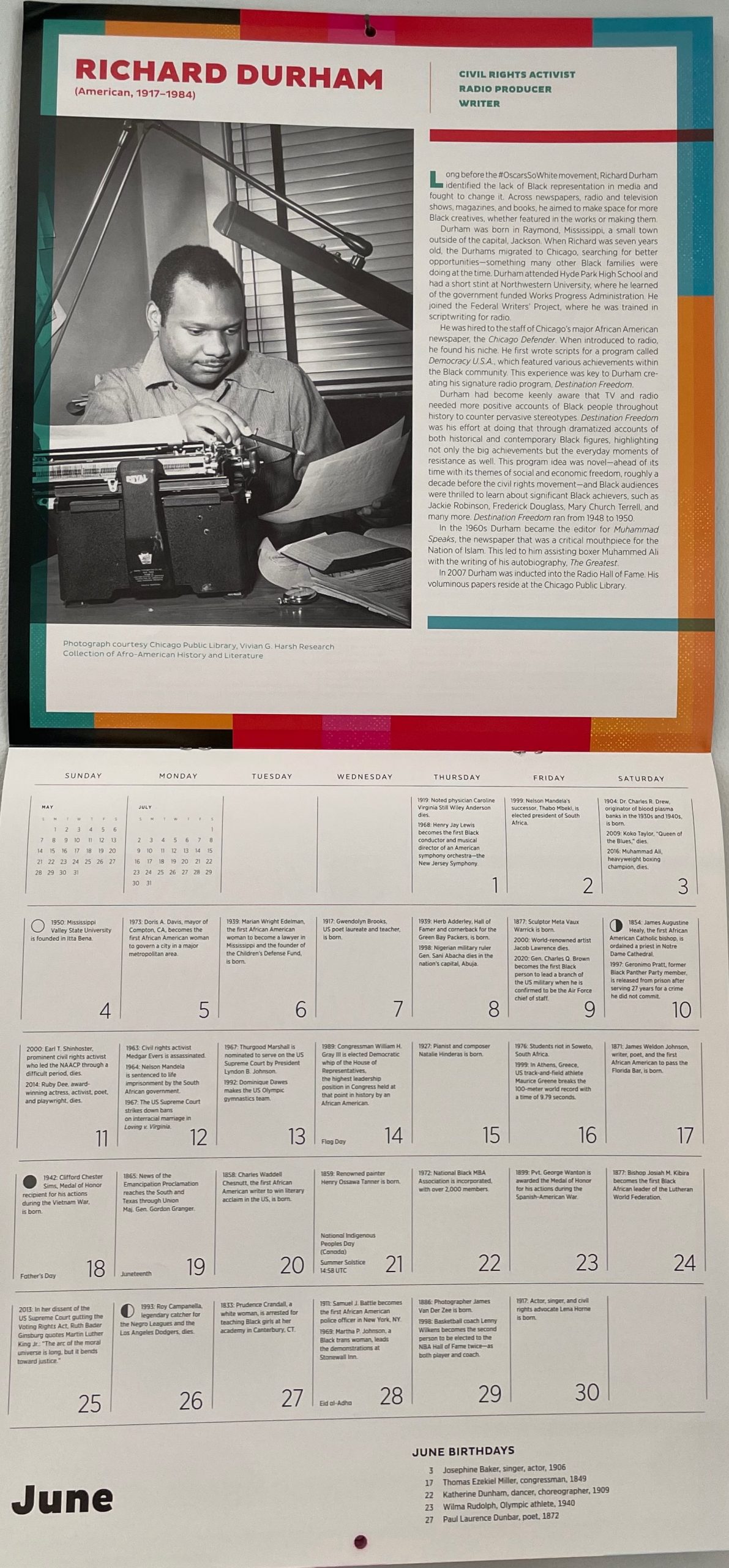
Continuous Wave: “The Price I Pay To Be Free,” and the Timeless Radio of Richard Durham

Each week, journalist Julia Barton whips out her fascinating online newsletter, Continuous Wave. It explores the forgotten history of broadcast and all electronic media, and she recently featured an excerpt from my biography of Radio Hall of Fame writer Richard Durham.

Please see Julia’s introduction to her post below,  and then check out her newsletter excerpt on Durham by clicking on The Price I Pay to be Free link.

Happy Reading!

Note from Julia: I’ve said it before — US network radio in the 1920s and 1930s was an absolute embarrassment when it came to race. Not only did early radio deploy crude ethnic stereotypes — with popular shows like Amos’n’Andy built around the “racial ventriloquy” of white men depicting Black characters — but it was almost impossible for actual Black people to get on network air as themselves, or Black writers to get dramatic scripts past gatekeepers.

That started to change with the onset of US involvement in World War II, as the government, which needed enlistment and buy-in from Black communities, asked radio to open its doors to more voices and points of view. From this opening came a new generation of Black radio actors and writers. One of the best was Richard Durham, a journalist with the Chicago Defender who in 1948 started the history series Destination Freedom on Chicago’s NBC powerhouse affiliate WMAQ (ironically, the same station where Amos’n’Andy got its start).

Howard University professor Sonja D. Williams has written a fascinating biography of Richard Durham called Word Warrior: Richard Durham, Radio, and Freedom. Williams is also a Peabody-award-winning audio producer, and it was in the course of researching the Smithsonian’s documentary series Black Radio: Telling It Like It Was that she first encountered Durham’s work. “I was struck by this series’ lyricism, dramatic flair, and fiery rhetoric,” she writes.

Today, with Williams’ permission, we’re bringing you the story of Destination Freedom, an excerpt from Word Warrior. After this, I hope that if you haven’t already, you’ll go read the whole book. Here’s Sonja Williams:

“The Price I Pay to Be Free” Sonja D. Williams on the timeless radio of Richard Durham


An Exciting Summer Book Sale is Back!

Summer’s here (Yay!)

And once again, the Unversity of Illinois Press (UIP)  is inviting book lovers to take advantage of its annual summer sale.

From June 1st through June 16th, ALL UIP books are discounted 50%.

So why not find your favorite UIP book – including my own book, Word Warrior: Richard Durham, Radio and Freedom  –  and pick it up for half price? You and your wallet will be pleased. 🙂

Click here for more details and enjoy!


Affirmative Action & Higher Ed – An Aural Case Study

About 25 years ago, in March 1998 to be exact, NPR’s Weekend Edition Saturday aired a documentary I produced that explored how affirmative action policies in higher education admissions and hiring practices affected students, faculty and staff at a specific university from the 1960s through the 1990s.

The piece, Affirmative Action and Higher Education: An Aural History, actually was an aural case study in which I captured the opinions and experiences of various members of the University of Chicago community – including prominent faculty like historian John Hope Franklin and sociologist William Julius Wilson, the university’s vice president for research (and former Morehouse College president) Walter Massey, and former students Christopher Kang and novelist A.J. Verdelle.

The insights of those interviewees along with many others at this elite university, continue to resonate in light of the U.S. Supreme Court’s current ruling against the affirmative action policies of Harvard University and the University of North Carolina – and its broader implications for higher ed.

To hear my piece, please click on the following link: Affirmative Action and Higher Education

error: Content is protected !!